Top Aviation Events in America: Definitive Airshow & Fly-in Guide
The North American aviation calendar represents a massive convergence of culture, technology, commerce, and public policy. Each year, millions of spectators, industry executives, private pilots, and defense contractors gather across the United States to observe flight demonstrations, inspect cutting-edge aerospace engineering, and participate in regulatory and trade discussions. These gatherings range from neighborhood grass-strip fly-ins to massive civil-military expositions that temporarily transform regional municipal airports into some of the busiest air traffic nodes in the world.
Understanding this landscape requires looking beyond the spectacle of smoke trails and high-speed military passes. Aviation gatherings serve critical functional roles within the global aerospace ecosystem. They operate as decentralized trade floors for general aviation aircraft sales, live proving grounds for defense technologies, primary recruitment vectors for military branches, and essential educational forums for safety, maintenance, and flight operations. The sheer scale and operational complexity of these gatherings make them a unique subject of study for aviation professionals and enthusiasts alike.
Navigating these gatherings successfully depends on recognizing how different event formats align with distinct participant goals. A pilot seeking hands-on maintenance workshops gains very little from a major defense expo oriented toward corporate procurement. Conversely, an defense contractor evaluating unmanned aerial systems will find little utility in a regional antique aircraft fly-in. Evaluating the top aviation events in america demands a structured approach that weighs logistical footprints, operational objectives, spectator accessibility, and airspace management strategies.
Understanding “Top Aviation Events in America”
Evaluating the top aviation events in america requires a nuanced definition of what constitutes top status. Surface-level coverage often ranks gatherings purely by attendance figures or headline military demonstrations. While attendance numbers provide a gauge of general public appeal, they frequently obscure the operational, economic, and educational importance of smaller, highly targeted gatherings. High spectator volume does not automatically equate to high value for pilots, industry stakeholders, or technology developers.
A major misunderstanding involves treating all large airshows as functionally identical. In practice, an event organized primarily for civic engagement and military recruitment operates under vastly different parameters than an experimental aircraft convention or a business aviation trade exposition. The former focuses on spectator control, public safety boundaries, and air demonstration routines. The latter prioritizes temporary flight line operations, workshop spaces, static display layouts, and B2B meeting venues. Oversimplifying these distinctions leads to mismatched expectations for both attendees and exhibitors.
Another common oversight is failing to account for the temporary airspace and infrastructure constraints these gatherings generate. When hundreds or thousands of aircraft converge on a single airfield over a few days, the local aviation system faces intense operational stress. Success depends on temporary air traffic control procedures, specialized arrival routing, surface management, and ground logistics. Assessing the top aviation events in america therefore demands an evaluation of how effectively an event manages its operational environment alongside its public programming.
Deep Contextual Background
The historical evolution of American aviation gatherings parallels the development of flight technology and public policy throughout the twentieth century. Early aviation events in the 1910s and 1920s were largely barnstorming exhibitions and high-stakes air races, such as the National Air Races in Cleveland. These early gatherings tested engine reliability, aerodynamic design, and pilot endurance. They provided a public proving ground for an industry still trying to demonstrate its practical utility to skeptical investors and government bodies.
Following World War II, the nature of these gatherings shifted dramatically. The sudden surplus of military aircraft, combined with a surge of civilian pilots trained during wartime, fueled a rapid expansion in general aviation. Organizations like the Experimental Aircraft Association (EAA), founded in 1953, transformed grassroots gatherings from local stunt displays into structured educational conventions focused on homebuilt designs, restoration, and flight safety.
By the late twentieth century, military airshows and commercial trade exhibitions had specialized further. The Cold War era elevated military open houses into primary public relations tools, demonstrating air power and technological superiority. Concurrently, commercial venues like the National Business Aviation Association (NBAA) convention emerged to serve corporate flight departments, charter operators, and business jet manufacturers. Today, the sector is a mature, highly regulated ecosystem balancing public entertainment, safety, and commercial enterprise.
Conceptual Frameworks and Mental Models
Analyzing the top aviation events in america requires dynamic frameworks that capture how different operational variables interact during a major event.
The Density-Complexity Matrix
This framework plots an event based on aircraft density against operational complexity. Low-density, low-complexity events include local airport open houses with basic static displays. High-density, high-complexity events—such as EAA AirVenture Oshkosh—combine thousands of aircraft movements with non-standard visual approach procedures, mixed aircraft performance categories, and temporary air traffic control towers.
The Audience Purpose Triad
This model categorizes gatherings based on the primary motivation of their core audience: Spectacle, Education, or Commerce.
-
Spectacle-driven events prioritize high-energy aerobatics, military Jet Demonstration Teams, and large spectator crowds.
-
Education-driven events focus on type-specific seminars, safety briefings, hands-on construction workshops, and regulatory forums.
-
Commerce-driven events center on static display rows, vendor exhibit halls, contract negotiations, and fleet purchasing decisions.
The Airspace Resource Framework
This framework evaluates how an event consumes local airspace and ground resources. It balances runway capacity, ramp space, visual separation safety buffers, and temporary flight restrictions (TFRs) against normal regional air traffic flows. Understanding this balance highlights why certain locations can host mega-events while others are constrained by surrounding controlled airspace or urban encroachment.
Key Categories and Major Event Types
The landscape of major American aviation gatherings spans several distinct operational profiles, each serving a unique segment of the aviation community.
General Aviation and Experimental Conventions
These mass fly-in conventions feature high aircraft volumes, extensive static displays, workshops, and flight demonstrations. EAA AirVenture Oshkosh in Wisconsin stands as the premier global example, temporarily turning Wittman Regional Airport into the busiest airport in the world. SUN ‘n FUN Aerospace Expo in Lakeland, Florida, provides a major early-season counterpart, drawing thousands of general aviation pilots to the Southeast.
Commercial and Business Aviation Expositions
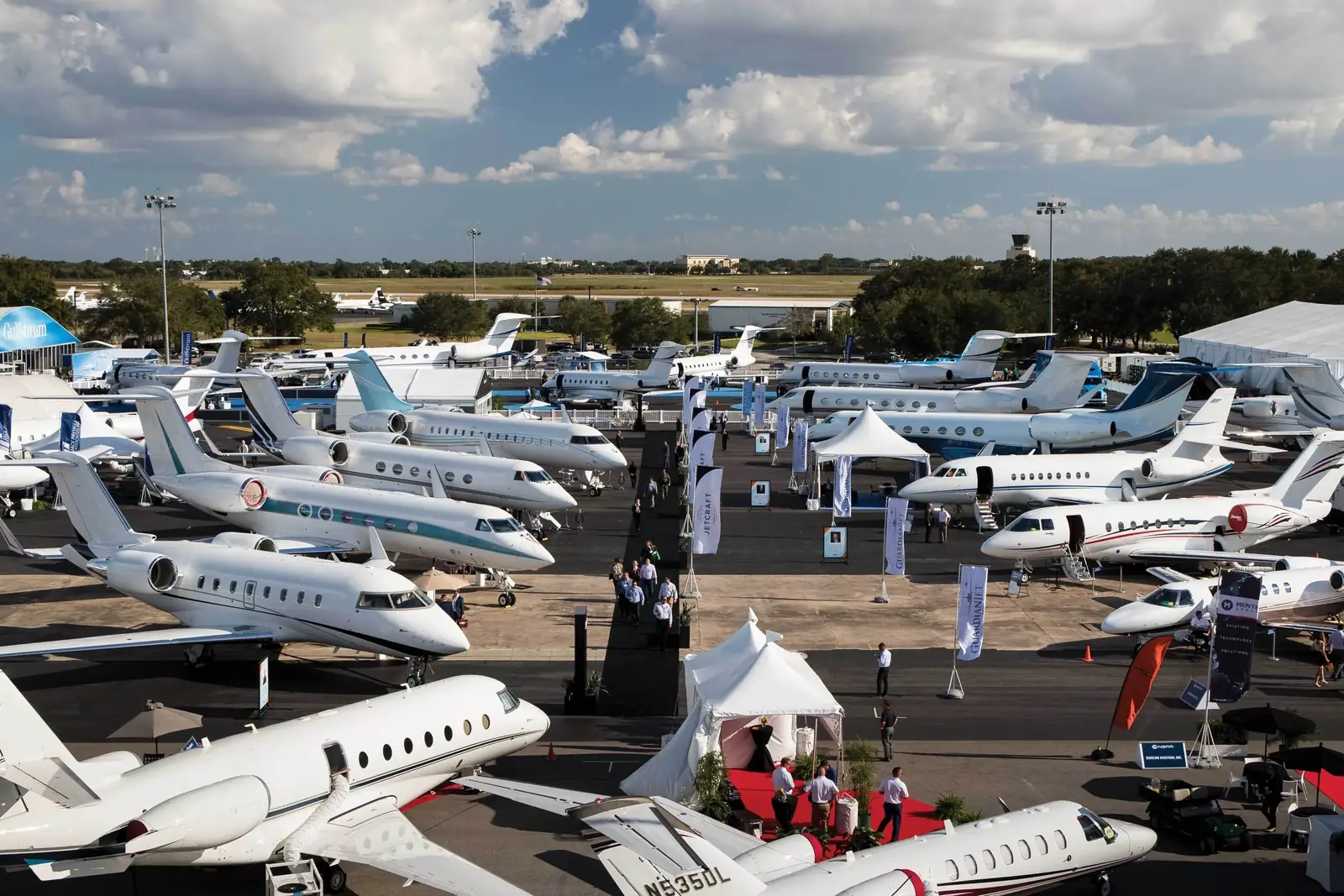
Focused strictly on enterprise, corporate flight operations, and fleet procurement, these events feature vast indoor exhibition spaces paired with static displays of business jets and turboprops. The NBAA Annual Meeting & Convention (NBAA-BACE) rotates through key convention hubs, bringing together aircraft manufacturers, avionics firms, charter brokers, and corporate flight department managers.
Military Open Houses and Joint Service Airshows
Hosted on active military installations, these public open houses showcase defense capabilities, static fighter and transport fleets, and aerial demonstrations by groups like the USAF Thunderbirds or US Navy Blue Angels. Events like the MCAS Miramar Air Show in California demonstrate operational readiness while driving recruitment and community outreach.
Historic and Warbird Fly-Ins
Dedicated to preserving, restoring, and operating vintage military aircraft, these gatherings draw specialized collectors, historians, and veterans. Events like the Mid-Atlantic Air Museum’s World War II Weekend in Reading, Pennsylvania, combine ground living history re-enactments with rare, authentic flight demonstrations.
Specialized Air Races and Precision Competitions
These high-speed or high-skill events test engine performance, aerodynamic modification, and pilot precision. The STOL (Short Takeoff and Landing) Competitions, held in various regional venues, focus on low-speed control, backcountry utility, and precise handling characteristics on unimproved surfaces.
Regional Fly-Ins and Grassroots Rallies
Smaller, community-focused fly-ins take place at non-towered municipal or turf airfields. These events prioritize pilot fellowship, type-club gatherings, and local aviation advocacy, offering accessible entry points without the logistical complexity of national conventions.
| Category | Primary Focus | Key Participants | Airspace Complexity | Infrastructure Requirements |
| GA & Experimental | Education, Homebuilding, Fly-in Culture | Private Pilots, EAA Members, OEMs | Extremely High (NOTAM procedures) | Vast Grass/Paved Ramps, Campsites |
| Business Aviation | B2B Commerce, Corporate Procurement | Corporate Executives, Charter Ops, OEMs | Moderate (Standard IFR/VFR) | Large Convention Centers, FBO Ramps |
| Military Open House | Recruitment, Public Relations, Demo Teams | General Public, Military Personnel | High (Strict Airspace TFRs) | Active Military Runways, High Ramp Capacity |
| Historic & Warbird | Heritage Preservation, Flight Demos | Collectors, Historians, Veterans | Moderate to High | Paved Runways, Vintage Hangar Storage |
| STOL & Air Racing | Aircraft Performance, Pilot Skill | Specialized Pilots, Modifiers | High (Low-altitude Coordinated Courses) | Dirt/Turf Strips or Dedicated Flight Corridors |
Realistic Event Selection Decision Logic
Selecting which major aviation event to attend or participate in depends on clear, objective criteria.
-
Identify the Core Operational Goal: If the primary objective is technical skill development, builder assistance, or general aviation advocacy, select a major experimental/general aviation convention. If the goal is enterprise networking or aircraft acquisition, select a business aviation trade exposition.
-
Evaluate Logistics Capability: Attending high-volume fly-in events requires comfort with non-standard visual arrival procedures, slot reservations, and high-density ramp parking. Pilots unprepared for complex arrival NOTAMs should opt for commercial transit or smaller regional fly-ins.
-
Assess Infrastructure and Support Needs: Vendors and exhibitors must match their ground support requirements (power, air-conditioned exhibit space, heavy freight handling) with the event’s underlying infrastructure.
Detailed Real-World Scenarios
Scenario 1: Navigating Oshkosh VFR Arrival Procedures
During the peak arrival window for a major general aviation convention, non-towered visual procedures take effect over specific waypoints. Pilots must maintain strict altitude, airspeed, and distance spacing while monitoring a dedicated arrival frequency without transmitting unless requested.
The primary failure mode occurs when a pilot fails to maintain target airspeed, creating a bottleneck for trailing aircraft and forcing a go-around into congested airspace. The proper decision point requires recognizing spacing breakdown early, diverging safely to the designated holding pattern over a nearby lake, and re-entering the flow without compromising safety margins.
Scenario 2: Exhibiting at a Business Aviation Expo
A mid-sized avionics manufacturer plans to launch a new flight deck system at a commercial trade convention. The company faces high booth costs, strict setup schedules, and fierce competition for media visibility.
A failure point occurs when static display scheduling conflicts with media briefing windows, splitting the sales team across two sites. By establishing clear operational roles beforehand and placing interactive demonstration units in the main exhibition hall, the company maintains steady engagement with both corporate flight department buyers and media outlets.
Scenario 3: Managing Airspace for a Military Installation Open House
An active air base hosts a two-day public open house featuring a jet demonstration team. The event requires closing nearby civilian airspace corridors, establishing temporary flight restrictions (TFRs), and coordinating with local air traffic control towers.
If a civilian aircraft strays into the TFR due to outdated pre-flight charts, aerial demonstrations must pause immediately. Mitigating this risk requires publishing extensive airspace notices weeks in advance, conducting outreach to surrounding general aviation airports, and maintaining active radar monitoring throughout the airshow window.
Scenario 4: Operating an Antique Aircraft Fly-In on a Turf Strip
A regional historic aviation club hosts a vintage aircraft fly-in at an uncontrolled grass airfield. Many participating aircraft lack electrical systems, radios, or modern avionics, relying entirely on visual separation and wind tees.
The primary hazard is a sudden crosswind shift combined with mixed aircraft performance types—such as a fast World War II trainer trailing behind a slow 1930s biplane. The air boss must establish clear visual signals, assign ground spotters along the runway edge, and separate flight patterns by performance class to maintain safe operational margins.
Planning, Cost, and Resource Dynamics
Participating in major aviation gatherings involves both direct financial expenses and significant resource commitments. Expenses vary widely depending on whether a participant attends as a general spectator, a fly-in pilot, or a corporate exhibitor.
Direct costs for fly-in participants include fuel, oil, aircraft tie-down fees, temporary insurance endorsements, and transient camping or lodging arrangements. Indirect costs include aircraft maintenance wear-and-tear, potential flight delays caused by weather, and the opportunity cost of dedicated travel days. Exhibitors face a larger cost footprint, including booth space rentals, aircraft staging costs, freight shipping, display setup labor, and hospitality arrangements.
| Cost Category | Low-End Estimate (General Spectator / Fly-in) | Mid-Range Estimate (Dedicated Pilot / Owner) | High-End Estimate (Corporate Exhibitor / Sponsor) |
| Travel & Transit | $50 – $200 (Ground driving / local) | $500 – $1,800 (Avg GA flight fuel & oil) | $5,000 – $25,000 (Corporate fleet positioning) |
| Lodging & Camping | $30 – $100 / night (On-field camping) | $150 – $350 / night (Regional hotel) | $400 – $900 / night (Premium hotel suites) |
| Access & Registration | $40 – $90 / day (General admission) | $200 – $400 (Weekly member pass) | $2,500 – $50,000+ (Exhibitor space & passes) |
| Ground Operations | $0 – $20 (Basic tie-down) | $50 – $200 (Field services, fuel service) | $2,000 – $15,000 (Ramp service, power, logistics) |
| Contingency Reserves | $100 – $300 (Weather delays) | $500 – $1,500 (Maintenance / diversion fund) | $5,000 – $20,000 (Operational delays, schedule shifts) |
Tools, Strategies, and Support Systems
Successful attendance or participation at major American aviation events depends on specialized tools, strategies, and operational support systems.
Specialized Event NOTAMs and Arrival Procedures
Major fly-in events publish comprehensive Notice to Air Missions (NOTAM) booklets outlining specific visual flight rules (VFR) and instrument flight rules (IFR) arrival paths, altitudes, frequencies, and taxi routes. Reviewing and printing these procedures beforehand is essential for safe operation.
Electronic Flight Bags (EFBs) and Georeferenced Charts
Modern EFB applications allow pilots to overlay event-specific arrival waypoints, temporary flight restriction zones, and complex taxi diagrams directly onto moving map displays. This greatly reduces pilot workload during critical phases of flight.
Portable Aircraft Tie-Down and Ground Support Equipment
Events with grass parking require pilots to bring specialized claw-style ground anchors, heavy-duty ratchet straps, pitot tube covers, and sunshades. Sturdy tie-down equipment protects aircraft from sudden storm fronts or jet wash on crowded ramps.
Mobile Avionics Charging and Power Management
With long days spent on active ramps far from electrical outlets, portable power banks, solar chargers, and auxiliary battery units are critical for keeping flight planning tablets, handheld VHF radios, and GPS units charged.
Temporary Flight Service Stations and Mobile Control Towers
Federal Aviation Administration (FAA) controllers deploy mobile control units to manage high-volume events. Understanding how these temporary facilities operate—often utilizing visual flaggers and discrete frequencies—helps pilots anticipate controller instructions.
Ground Transportation and Micro-Mobility Solutions
Navigating expansive airfields like Oshkosh or Sun ‘n Fun requires a clear ground transport strategy. Attendees rely on organized field trams, folding bicycles, or electric scooters to move efficiently between flight lines, exhibit halls, and camping areas.
Risk Landscape and Failure Modes
The high operational density of major aviation gatherings introduces unique risks that require careful mitigation strategies.
Pilot Task Saturation and Loss of Situational Awareness
Fllying complex, non-standard visual arrivals into congested airspace can overwhelm pilots accustomed to quiet, towered airports. Task saturation can lead to altitude deviations, improper airspeed management, or failure to spot converging traffic. Mitigation: Thoroughly brief arrival procedures beforehand, fly with a qualified safety pilot when possible, and execute an early diversion if weather or traffic spacing deteriorates.
Rapid Weather Deterioration on Exposed Ramps
Summer aviation events frequently coincide with high heat and afternoon thunderstorm activity. Unprepared airfields can experience microbursts, high winds, and torrential rain that threaten unsecured aircraft and temporary structures. Mitigation: Monitor micro-weather updates constantly, secure aircraft with heavy-duty anchors immediately upon parking, and identify sturdy shelter locations ahead of time.
Heat Exhaustion and Physical Fatigue
Spectators and flight crews often spend long hours walking on hot asphalt ramps with minimal shade. Dehydration and heat exhaustion degrade judgment and physical reaction times. Mitigation: Maintain aggressive hydration schedules, utilize shaded shelter tents periodically, and monitor crew members for early signs of heat distress.
Governance, Maintenance, and Long-Term Adaptation
Operating large-scale aviation events requires continuous oversight, multi-agency coordination, and adaptive management framework.
Pre-Event Planning and Regulatory Approval
Planning begins up to a year in advance. Event organizers work closely with the FAA, local airport authorities, emergency services, and municipal government departments. This stage secures necessary airspace waivers, publishes specialized NOTAMs, and establishes clear emergency response protocols.
Active Event Monitoring and Real-Time Adjustments
During the event, a dedicated Air Boss, safety officers, and FAA controllers monitor operations continuously. If weather conditions worsen, runway closures occur, or airspace congestion peaks, organizers adjust schedule routines, pause flight demonstrations, or hold incoming arrivals at outer waypoints.
Post-Event Review and Safety Debriefs
After the airfield clears, event leadership conducts thorough debriefs with air traffic controllers, safety crews, and municipal agencies. Incidents, near-miss reports, and logistical bottlenecks are analyzed to update standard operating procedures for future event cycles.
Layered Operational Checklist for Event Attendees
-
Pre-Flight Planning Phase
-
Download and print the current event NOTAM and arrival procedures.
-
Verify aircraft weight and balance limits, including gear and passengers.
-
Confirm insurance coverage for open-field parking or event attendance.
-
Pack specialized ground support gear: tie-downs, canopy covers, oil, and tools.
-
-
In-Flight Approach Phase
-
Brief the arrival procedure waypoints, altitudes, and airspeeds early.
-
Turn off non-essential cockpit chatter and assign visual scanning roles.
-
Monitor designated event arrival frequencies well before entry waypoints.
-
Divert immediately to an alternate airport if arrival holds exceed fuel reserves.
-
-
On-Ground Operations Phase
-
Follow ground spotter instructions precisely; maintain low taxi speeds.
-
Chock wheels and secure aircraft with high-rated tie-downs immediately.
-
Perform a complete post-flight check of the airframe, fuel, and tires.
-
Review daily departure procedures and weather forecasts before flight day.
-
Measurement, Tracking, and Evaluation
Evaluating the success and operational health of a major aviation gathering involves tracking both quantitative data and qualitative feedback.
Quantitative Metrics
-
Movement Counts: Total takeoff and landing operations managed by temporary air traffic control towers during the event window.
-
Safety Performance: Total number of reported airspace incursions, hard landings, ramp incidents, or medical responses.
-
Economic Footprint: Direct spending generated within the host municipality, measured through hotel occupancy, fuel sales, and local tax revenues.
-
Vendor & Sponsor Retention: The percentage of commercial exhibitors and corporate sponsors who renew contracts year-over-year.
Qualitative Metrics
-
Participant Experience Ratings: Post-event surveys measuring pilot satisfaction with arrival procedures, parking assistance, and safety briefings.
-
Educational Value: Feedback collected from technical workshops, safety seminars, and flight instruction forums.
-
Community Relations Impact: Assessing local resident feedback regarding noise mitigation, traffic management, and civic engagement.
Common Misconceptions and Oversimplifications
Myth 1: The largest airshow is always the best event to attend.
Correction: Event quality depends entirely on participant goals. A pilot seeking hands-on builder advice will gain far more from a specialized regional fly-in than a massive military airshow focused primarily on general public entertainment.
Myth 2: Event NOTAM procedures are just suggestions for experienced pilots.
Correction: Special event NOTAMs are regulatory requirements. Ignoring published arrival altitudes, speeds, or entry waypoints compromises flight safety and can lead to FAA enforcement action.
Myth 3: Military airshows are only meant for public entertainment.
Correction: Military open houses serve vital strategic functions. They act as primary recruitment tools, foster community relations, and give the public a transparent look at military readiness and hardware.
Myth 4: Any public airfield can host a major national fly-in event.
Correction: Hosting high-volume events demands vast physical infrastructure, including high-capacity taxiways, extensive unpaved ramp space, dedicated emergency response assets, and compatible surrounding airspace.
Myth 5: Business aviation conventions are open public fly-ins.
Correction: Major business aviation expos are professional trade shows. They require corporate registration, prioritize industry access, and generally do not feature public aerobatic routines or open ramp access.
Myth 6: Weather diversions during major fly-ins indicate poor flight planning.
Correction: Choosing to divert to an alternate airfield due to weather or arrival congestion demonstrates sound judgment and proper risk management, reflecting high standards of airmanship.
Ethical, Practical, and Contextual Considerations
The execution of major aviation events involves balancing environmental impact, public safety, and community relations. Flight demonstrations consume significant fuel volume and generate elevated noise levels around host communities. Responsible organizers work closely with local municipalities to publish noise-abatement routes, schedule flights during reasonable hours, and invest in carbon-offset initiatives where feasible.
Public safety remains the fundamental ethical imperative. Airshow organizers, demonstration pilots, and safety directors operate under strict FAA safety buffers. Aerobatic routines are positioned away from spectator lines to minimize risks to non-participants. Maintaining these stringent boundaries protects both the public and the long-term viability of the aviation event industry.
Conclusion
Evaluating the top aviation events in america requires looking beyond sheer spectator numbers to appreciate the complex operational, educational, and commercial networks that sustain them. Whether managing thousands of general aviation arrivals over the Wisconsin countryside or hosting international corporate transactions in a major metropolis, these gatherings reflect the scale and vitality of American aerospace culture. By approaching these events with rigorous operational preparation, clear personal objectives, and a deep respect for safety, participants can fully engage with everything the national aviation landscape has to offer.